Marriage
The Canterbury TalesMarriage in The Canterbury Tales is never merely a private romance. It is a public, legal, and religious form that can transform desire into recognized union, redistribute social and economic security, and expose the tensions between authority and devotion. The marriages of Palamon and Emily and of Arveragus and Dorigen present two sharply different models: one culminates in ceremony, prosperity, and reciprocal tenderness, while the other is founded on a carefully negotiated paradox in which each spouse is at once servant and lord.
Definition and Social Form
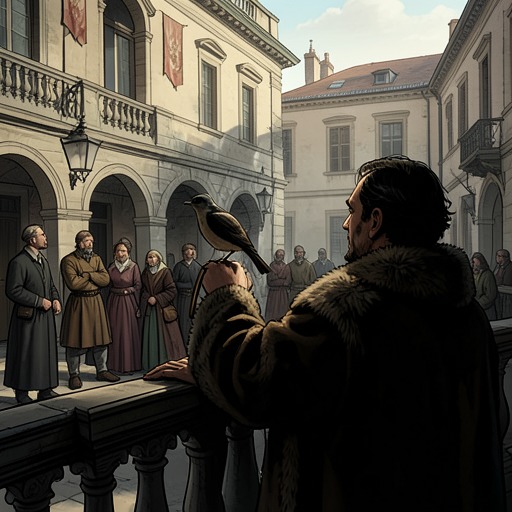
Marriage appears as an institution whose legitimacy depends on more than affection. In Palamon and Emily’s case, the union is enacted before the council and the baronage, making their private attachment a publicly witnessed settlement. The ceremony joins them in a holy union, and the surrounding courtly setting gives the marriage social as well as emotional authority. Marriage therefore converts a contested claim to love into an order that the community can acknowledge.
The text also connects marriage with judgment and governance. Palamon is not simply allowed to take Emily because he desires her; the decision is framed through Theseus’s authority and a principle of mercy that can transcend social station. Once Theseus directs Palamon to take Emily by the hand, the two are joined before institutional witnesses. Their marriage consequently resolves a conflict that had involved imprisonment, rivalry, and the competing claims of two knights, while placing the outcome within a recognized civic and religious framework.
Palamon and Emily
The marriage of Palamon and Emily is the fulfilled conclusion of a long struggle in which love has been entangled with violence and public order. After Arcite’s death, Theseus turns from the immediate tragedy toward a durable arrangement for the survivors. His decision permits Palamon to receive Emily rather than leaving the contest suspended between rival claims. The wedding is presented as a moment of joining, music, and collective happiness rather than as a private elopement or clandestine bargain.
The consequences are explicitly material as well as emotional. Palamon possesses wealth sufficient to live in bliss, richness, and health, and Emily loves him tenderly. Their prosperity marks a decisive reversal from the poverty, confinement, and uncertainty that had surrounded the earlier stages of the conflict. The marriage thus produces social stability: the surviving lover gains not only the woman he sought but also an established household and the resources to sustain it.
The union also gives retrospective shape to the violence that preceded it. The tournament and Arcite’s death have destroyed the possibility that both rivals might claim Emily, but Theseus’s settlement prevents that destruction from ending in permanent disorder. Marriage becomes the mechanism through which loss is incorporated into a new social arrangement. Its happiness is therefore real, yet it is also the final form imposed on a history of rivalry by political and ceremonial authority.
Arveragus and Dorigen’s Compact
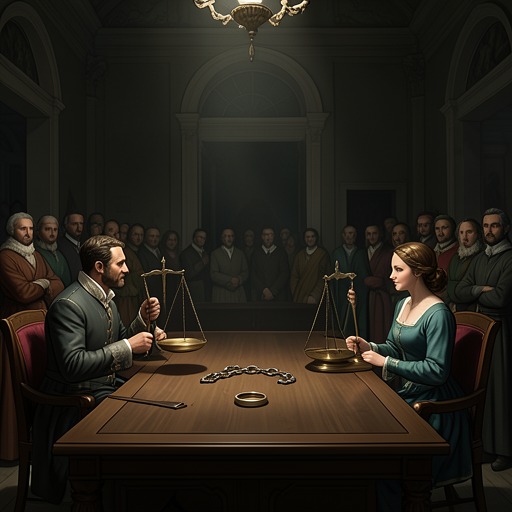
The relationship between Arveragus and Dorigen develops a different theory of marriage. Dorigen privately agrees to take Arveragus as her husband and lord and to grant him the lordship customarily exercised by men over wives. The language invokes hierarchy, but the arrangement is presented as an intentional compact rather than as an unquestioned natural fact. Dorigen chooses to enter the structure and thereby makes the marriage’s authority part of a negotiated exchange.
Yet the apparent submission is immediately complicated by the terms of the couple’s agreement. Dorigen asks for such freedom of rein that no war or strife should ever arise between them through her fault. She pledges to be Arveragus’s true and humble wife, and the promise is represented as relieving and reassuring both partners. The marriage therefore joins formal asymmetry to an aspiration toward peace: one spouse is named lord, while the other seeks enough freedom for the relationship not to become coercive conflict.
The narrator later condenses this paradox into a formulation in which Dorigen takes Arveragus as both servant and lord, with service understood as service in love and lordship as lordship in marriage. The distinction matters because it prevents the arrangement from being read as simple domination. Arveragus retains the title and authority associated with marriage, but Dorigen’s love and consent give the relationship its emotional legitimacy. He is her lady’s servant in devotion even while he is her husband and lord in the social form of the union.
Authority, Consent, and Obligation
The two marriage models reveal different ways in which authority becomes acceptable. Palamon and Emily’s union is authorized from above by Theseus and ratified through the council, baronage, and holy ceremony. Arveragus and Dorigen’s union is shaped from within by private promises concerning lordship, freedom, fidelity, and the avoidance of strife. One marriage is publicly arranged after a crisis; the other is privately negotiated before later crises test its promises.
Marriage also makes speech consequential. Dorigen’s declaration that she will remain a true and humble wife until her heart breaks is not decorative courtly language; it establishes an obligation that governs subsequent action. Her promise binds her because marriage in the tale is made through words as well as ceremony. The relationship’s stability depends on whether freedom, service, and fidelity can coexist without one promise destroying another.
This structure places marriage close to law while keeping it distinct from mere legal compulsion. The language of lordship, wifehood, consent, and lawful dwelling gives the union a formal grammar, but the emotional force of the compact comes from willing participation. The tale repeatedly tests whether an institution can preserve affection when it contains unequal titles and binding duties. Marriage is strongest when authority is moderated by mercy, consent, and reciprocal care.
Narrative and Thematic Significance
Marriage functions as a form of social reordering. In the Palamon and Emily plot, it gathers the remains of a violent contest into a legitimate household and replaces rivalry with prosperity. In the Arveragus and Dorigen plot, it becomes an experiment in balancing sovereignty and service, asking whether a spouse can be both subordinate in name and free in the lived relation of love.
The contrast also broadens the meaning of marital happiness. Palamon and Emily receive public celebration, wealth, health, and tender affection after the settlement of a tragic conflict. Arveragus and Dorigen receive no similarly simple image of concord; their happiness depends on maintaining a difficult arrangement whose terms must be continually interpreted. Together, the marriages show that the institution can promise both security and danger, depending on how authority is exercised.
Marriage finally serves as a testing ground for the poem’s larger concern with promises and human governance. A wedding may solemnize desire, but it also creates duties that outlast the moment of celebration. The most persuasive marriages in the work are not those without hierarchy or hardship; they are those in which hierarchy is tempered by love, obligations are treated seriously, and public or private authority is prevented from becoming sheer force.